
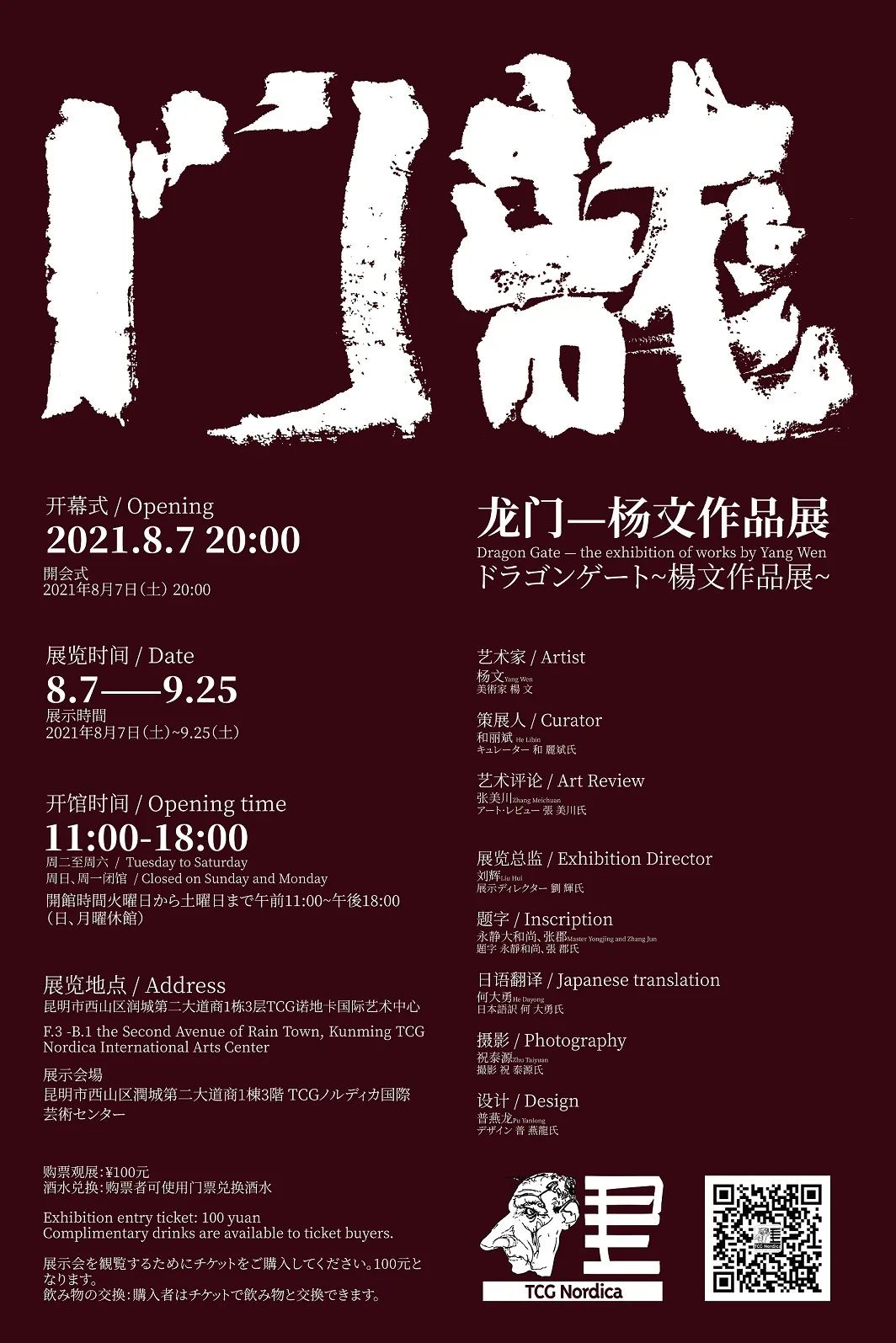
_
The Leap of Freedom and the Possibility of Art Redemption on Yang Wen’s Abstract Art
2021.08.07 – 2021.09.25
BY Zhang Meichuan
Doctor of Sociology, Peking University
Teacher of Department of Sociology, Yunnan University
Translated by Yibing Li
Graduate student in Sociology, Yunnan University

Strange Fruit
Oil on canvas
100x100cm
39 3/8×39 3/8 in
2014-2019
Yang Wen ©
1.
In the preface to his book Die Geburt der Tragödie (The Birth of Tragedy), Nietzsche wrote: “Art is the highest mission of mankind, and it is the true metaphysical activity.” At the moment of the advent of modernity, where values tend to be nihilistic, it is easy to see how Nietzsche’s statement follows the path of ancient Greece, reveals the Dionysian spirit in it, and opening his eyes to the will of power to smash idols and reevaluate all values. Italian political philosopher Giorgio Agamben believes that art is the fundamental feature of Nietzsche’s will to power. For Nietzsche, it is artists who can overcome nihilism in modernity and redeem the chaos of the age.
In this way, the artist is imperceptibly bearing a heavy mission like a crucifix. It is also Agamben, in his art criticism The Man Without Content, keenly points out that the so-called artist legislates for himself does not mean that after the artist realizes the charm of his own creative skills, he obtains some otherworldly independence without any interest. Rather, it involves the inevitable paradox of modernity: as modern division of labour creates divisions, the specialization of art makes it, at least ostensibly, a separate domain, but the audience of art in the same domain is moving away from the artist as creator. Audiences increasingly fall into the stylized conceptual system of art and are confined to the cloud of aesthetics, while artists just go in the opposite direction, taking risks on the road towards the extreme experience of “sacred terror” brought by creation. Its radicalism can be seen in a note found in Van Gogh’s pocket after his death: “Ah, when it comes to my work, I have put my life on the line, and my sanity has half melted in it.” Or read Rilke’s letter to Clara Rilke: “A work of art is always the product of an adventure, the result of an extreme experience that drives one to the brink.”
It is from the perspective of the divided artists that Agamben set out the question of art of our time: perhaps the most urgent task is to break down the idea of aesthetics, to clear away what we have previously taken for granted, in order to ask what is the fundamental significance of aesthetics as a knowledge about works of art. Obviously, the inner ethos of this question is exactly the same as Nietzsche. Agamben’s question is: after the destruction of aesthetic concepts, will all the horizons for understanding artworks disappear, leaving an abyss that can only be surpassed by a fundamental leap? Perhaps such loss and abyss are exactly what we need to restore art to its “original status”.
It should be further explained that Max Weber, one of the founders of modern social science, also raised the issue of artistic modernity in a different language when talking about the issue of religious rationalization. Religion was once an inexhaustible source of artistic creation, as well as a source of stylizing artistic creation by confining it to tradition. With the rationalization of religious ethics and the development of the inherent law of art, there is a growing tension between the two: when art embraces its independent inherent value, in Weber’s eyes, it has the redemptive function of rescuing human beings from the routine of daily life. But in this way, art and redeeming religion are in direct competition. However, modern people avoid moral judgment and gradually change the ethical value judgment to the judgment of appreciation. “This transformation from moral judgment to aesthetic judgment of individual behavior is the general feature of the age of subjectivity intellectualism…partly from fear of showing a traditionalist and uneducated narrowness of perspective.” In other words, the tension between art and redeeming religion is largely due to the dilemma of modern art: it has to compete with redeeming religion in value selection; In terms of its own creative breakthrough, art should find a new expression language in the entanglement with tradition and religion, and ought to get rid of the inherent ethical norms imposed on artists’ creativity and inner self.
The artist’s creation is like a leap into the abyss. For the audience, this leap has the meaning of art education. Due to the aforementioned relationship between the art audience and the artist, exquisite modern categories such as “appreciation”, “interest” or “taste” of art construct various divisions, which ultimately hurt the artist himself: “The artist slowly moves into an increasingly free and thin atmosphere. The journey will take them out of the living fabric of society and into the no man’s land of aesthetics in the far north. They will search in vain for food in this barren land, and eventually become like the Catoblepas in Flaubert’s ‘The Temptation of Saint Anthony’, who unconsciously begins to eat its own hands and feet.”
Therefore, breaking old-fashioned concept of aesthetic and taste, in the face of the highest mission requirements, with extreme adventure experimental attitude to accommodate individual life and the experience of epochal, embracing nihility at the same time, to give their charisma, in order to overcome the rationalization lead to the routine of everyday life and salvation of art — this kind of difficult duty poses a great challenge to modern artists. The spiritual tension constitutes the basic background of artistic modernity.
This is the difficult situation the artists facing today. Artist Yang Wen is also in the middle of it, facing the abyss to ask his own art concept and the possibility of breakthrough.
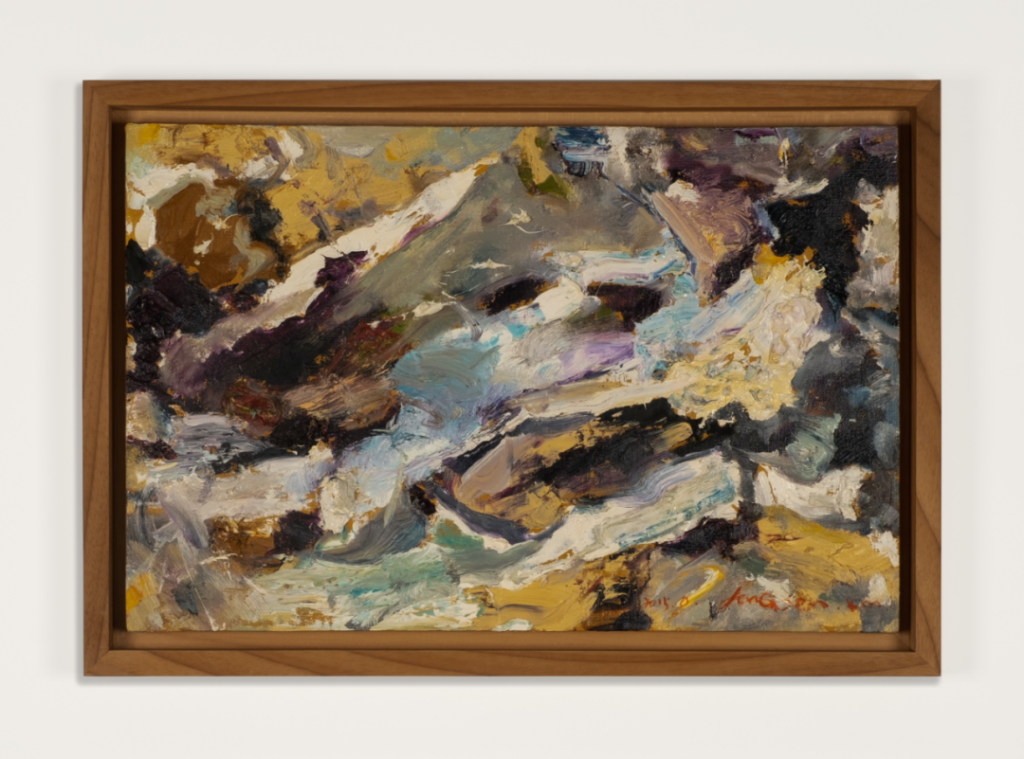
Untitled
Oil on canvas
40x60cm
15 3/4×23 5/8 in
2015
Yang Wen ©
2.
In a conversation supposedly titled “Art is a way of life,” Willem de Kooning said that what fascinates him was making something that he could never be sure of, and that no one else could be sure of. He would never understand, and neither would anyone else. This is the “positive nihilism” recognized by artists from the perspective of their own creation, and the uncertainty contained in it is just verified in another dimension of the development of modernity – the art market. As a very important part of modern art creation and life experience, the relationship between the artist and the market, in fact, often constitutes the source of the artist’s dilemma, and it is this point that also constitutes the possibility of the development of free spirit.
Olav Velthuis’s book Talking Prices: Symbolic Prices or the Market for Contemporary Art made an in-depth study of the uncertainty of the Art Market. One memorable anecdote is that the early 20th-century Dutch art dealer J. H. De Bois took a self-portrait by the 19th-century Dutch artist Matthjs Maris in his suitcase on a trip to Switzerland. De Bois came to show the painting to a collector and sell it at an ideal price. Arriving at the Swiss border, De Bois was accidentally picked up by the authorities. The customs officers examined the painting carefully and decided to impose an import duty. De Bois then realized that he did not have enough money to pay the duty on the painting, because it was expensive, although the price was uncertain. At the same time, the customs officers drew a scale, calculated the duty according to the weight of the articles, and charged De Bois 13.5 francs — a negligible sum.
For all its dismay, customs also represents what Velthuis called a “pricing script for determining the value of material goods”. Clearly, there have been many different pricing scripts in art history. In Italy and Northern Europe, where artists were not rewarded for their originality until the 16th century and where the original concept itself had not even taken off, people were used to buy art copies. However, when the artist’s personal skill is introduced as a determinant of value, it leads to difficulties that cannot be accurately measured. This difficulty does not exist when pricing for material or graphics-related factors, that is to say, the change in pricing models from tangible pricing scripts to intangible pricing scripts based on artists’ skills introduces great uncertainty into the art market.
In the post-Cultural Revolution era, China has experienced three decades of rapid economic growth and rapid changes. With total sales estimated at 11.2 billion euros, according to a 2015 study, China has become the world’s second-largest art and antiques market after the United States and it is far and away the world’s largest emerging market for art and antiques. In his preface to the Chinese version of his book, however, Velthuis makes clear that despite its similarities to the Western art market, China’s art market is not entirely a product of learning from the West and globalizing. In fact, the global model has never been fully adopted in China. There are several notable differences between the Chinese and Western models, such as the relative lack of an independent, authoritative, non-commercial third party to determine the price of art in China, as well as a strong commercial gallery industry. This makes it difficult for Chinese artists to obtain exclusive gallery representation and promotion, which is the mainstream practice in the contemporary European and American art markets, or to get opportunities to show their work in independent institutions to advance their careers. In other words, on the one hand, the Chinese art market preliminarily establishes its own “legitimacy” through the “imitative isomorphism” of the European and American art markets; on the other hand, the differences between the Chinese and Western art markets clearly indicate that cultural and social and political factors lead to the immaturity of the Chinese art market. If Chinese artists were to rely on this fragile market, their works would be in a more uncertain situation than their Counterparts in Europe and the United States. At the same time, this situation also means that contemporary Chinese artists are facing more arduous challenges on their way to freedom from the constraints of economic necessity. This road to freedom is undoubtedly a “glorious thorns road” full of dim sparks.
In fact, according to Robert Hughes, Mark Rothko was not good at dealing with anything other than painting, especially money, which was one of the things he feared most and was least able to handle. What Rothko represents is the group of painters that characterised their time: abstract expressionists, confined deadly to a framework in which they could never hope to make money, most of whom, before 1950, could not even imagine an audience of a few dozen people for their work. Hughes does not see this as a good thing for artistic creation. He has a scathing critic of the American contemporary art market and argues that it affects their sense of authenticity as artists and as people: it is deeply intertwined with their distrust of material success. Indeed, even as he rose to fame, Rothko was still ill-equipped to deal with the fog of uncertainty in the market.
For a long time, Yang Wen upheld the artistic law of free exploration and defied the market and commercial operation. Under the circumstances of the great development of the art market promoted by neoliberalism (although its construction is still weak) and the social mainstream’s pursuit of material and the extreme decline of spirit, this kind of self-sacrificing art exploration is almost miraculous. Contempt for the market naturally led to exile from the market. Yang Wen lived an ascetic and simple life for a long time, which was in sharp contrast to the strong and spiritual will in his paintings. It is worth noting that in the past two years, his paintings have begun to undergo some changes: in addition to the changes in the size, the subjects of his paintings have gradually presented more reflections on the reality of the age (such as the works in the solo exhibition “Therapy” in 2020). No longer living in an either-or binary confrontation, Yang Wen is still wary of the market’s endless power of coercion and penetration, but he has learned to open up his experience through a mixture of asceticism and play. He experiences and learns the great uncertain force of the market in silence and makes it his basic experience of modernity. After all, the market is supposed to be the driving force of art, not the vanity fair of capital orgies; Respecting the law of the market, incorporating the law of the market into one’s own experience, and steadily advancing the art career in the antithesis of modernity of profession/Beruf is also the embodiment of the free spirit of modern art.
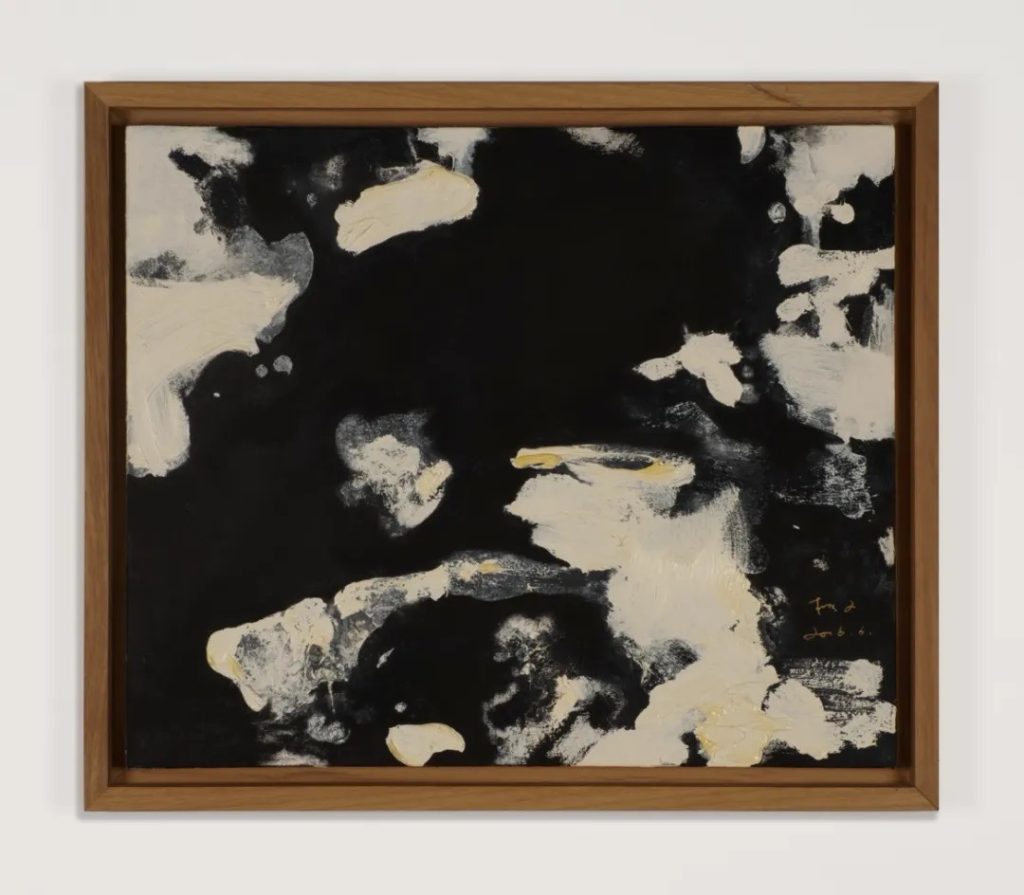
Untitled
Oil on canvas
50x60cm
19 11/16×23 5/8 in
2016
Yang Wen ©
3.
In 2015, an article by an anonymous author appeared on the Chinese Internet, criticizing sinicized abstract paintings as “completely fake modern art.” The central point of it is that Chinese artists and theorists have not accurately grasped the inner spiritual essence and open vitality of western paintings drawn from Wassily Kandinsky and Picasso. Since the very beginning of modern art represented by abstract painting, it has been full of strong subversion impulse, rebelled against all traditional culture and established authority, and its inner spirit is like Faustian passion to break all net and even close to self-destruction. China just lacks the foundation of modernity for modern art to be born. Therefore, in the name of returning to tradition, abstract painting in China is easily understood as freehand painting or image art in the crude method of attaining doctrine. This “Sinicization” of abstract art, in essence, is anti-modernity and a tool for evoking the ghosts of history. Because of its sharp views, the article has caused a lot of controversy. Those who agree (such as He Guiyan’s article “False Abstract, Flood”) believe that some artists once sought a shortcut to enter the art market under the guise of the avant-garde nature of abstract art, and at the same time to advertise their own elitism with the form of modernism. The key to identify whether a work is “pseudo-abstract” lies in whether the work can be positioned in the specific scene of art history, whether it can trace the artist’s personal creative context and response to the artistic concept, and whether the artist’s creative process has methodological consciousness. Opponents (such as Hang Faji’s “Pseudo-Modernity, Reflection and Rethinking of Art”) argue that the quality of the abstract art emphasizes the freedom of independent and absolute freedom of expression, traditional western abstract art as enlightenment, but it is not the only frame of reference of contemporary abstract art: from the view of transition, contemporary abstract art of frame of reference is the entire human culture background and the present living global cultural information code. Image and abstraction belong to different categories, but their boundaries are blurred. From the perspective of globalization pluralism and the tolerance and mutual infiltration of different human cultures, the technique of drawing on and infiltrating images in contemporary Chinese abstract paintings is entirely natural, and has nothing to do with the spiritualism of decadent history.
Simplistic judgments of right and wrong are not the purpose of this article. The problem consciousness brought out by the above disputes is very similar to the “dispute between ancient and modern, or between China and the West” once hotly discussed in the Chinese academic field, namely which is right and wrong between tradition and modernity, and what kind of relationship pattern China and the West are in. In other words, from the perspective of political philosophy, where will China go at the crossroads and what kind of historical destiny will it embrace? These grand questions are not easy to answer, but they call for more active, in-depth studies, such as: What is Chinese tradition? Are tradition and modernity completely separated? What kind of West? Has globalization led to pluralistic coexistence and the relative diminishment of the meaning of the nation-state, or is it still just a surface effect? Since the beginning of the 21st century, conservatism and nationalism have returned strongly, and the ideal of cultural universalism is gradually fading away. In reality, as Max Weber said, the eternal struggle between nation and culture cannot be avoided, and the patron spirits of each community are also at war with each other….These questions translate into questions in the field of art, namely, what is the tradition of painting in China? Is abstract painting inseparable from tradition? Learning the West means that we must pay attention to the ontological differences between Chinese and western culture and society. What is the modernity of abstract art? Is Faustian self-subversion and experimental creation possible in China?
Yang Wen’s long-term exploration in the field of abstract art (as the poet Rilke said: “living in the dark and working hard on his own”) has a lot of thoughts on the above theoretical issues, and gradually clearly presented the spirituality captured by these thoughts in his creation. He read widely and absorb western art wisdom crystallization, from Van Gogh, Cezanne, Antoni Tapies, Luc Tuymans, to, Raimund Girke, Joseph Beuys, Mark Rothko, Willem De Kooning, Cy Twombly, including the London school of the first generation of artists Leon Kossoff, Lucian Freud and Frank Auerbach, these artists have profound effect on Yang Wen. Impressively, Yang Wen’s “Laughter in the Dark” is a direct reference to Nabokov’s novel of the same name, which implies the same spirit of experimentation with various opposing layers of readers.
However, the understanding of the modern experience of abstract painting does not make Yang Wen’s free experiment into a floating exile without refuge. Free and brave experimental exploration is one aspect of Yang Wen’s abstract painting, but on the other hand, some profound and dignified testimonies in his works show the influence of traditional aspects in his artistic creation. This influence and the Faustian spirit of adventure from the West form a subtle counterpoint. The two are not the opposite relationship. In fact, it is precisely because of the traditional testimonies that the adventure of embracing nothingness in the void has a new meaning of destruction and rebirth.
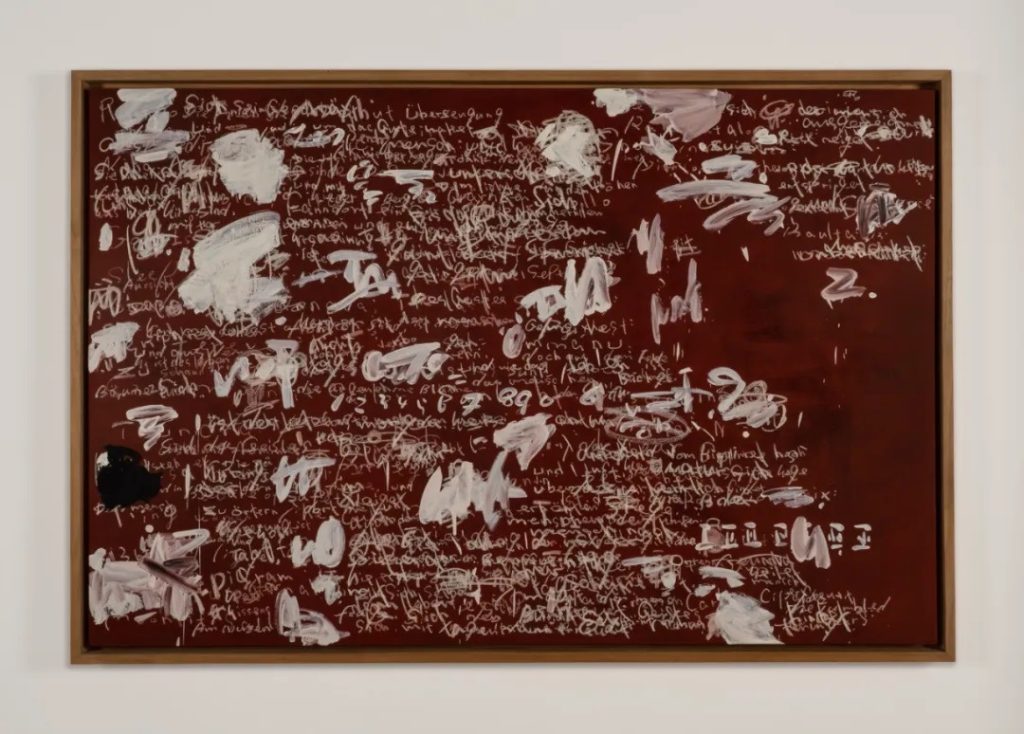
Untitled
Oil on canvas
120x180cm
47 1/4×70 55/64 in
2016-2017
Yang Wen ©
4.
Yang Wen’s daily life has a very solemn and respectful side, which is closely related to his close relationship with Buddhism. He took key concepts from Buddhist art, particularly thinking about the Sunyata view, and used them as an element in his work in a way that was almost unnoticed. Sunyata is at the heart of Mahayana Teaching and is one of the most difficult and misunderstood ideas in Buddhist doctrine. In Mahayana Paramitas, the sixth perfection is Prajna Paramita, but this embraces the other five perfect wisdoms, just for the realization of Sunyata. What is Sunyata? There is a saying in the Heart Sutra that “Seeing the five Skandhas are empty, crossing all bitterness”. The five Skandhas are form, feeling, perception, impulse and consciousness. These five parts make up all of us. Yet they are impermanent. Holding on to them as permanent “ego” causes greed and hatred, which is the source of suffering. In fact, the self does not exist, and according to the teachings of Mahayana Buddhism, all phenomena have no self essence. This is Sunyata.
In Yang Wen’s artistic creation, the breath and rhythm formed between various elements precisely remind us of the thought presented by the above Buddhist teachings: things have no essence, but this does not mean that things do not exist, nor does it mean that things exist. Rather, the world of phenomena is like a vast, ever-changing field or connection, in which all phenomena have no essence in the sense of interdependence. This is in accordance with the concept of inter-subjectivity in phenomenology which aims to capture this concept that the essence of subject and object dissolve in a relationship. Trust and compassion arise from the deep awareness of the non-ego, the mutual existence of oneself and the rest of the world.
To be clear, tradition is a highly ambiguous term. The concept of Buddhism and its origin is an important and unique part of Chinese cultural tradition. It is in the contrast of this unique tradition that people can find Yang Wen’s alienation from other secular traditions that persist in self-experience, such as his alienation from the community tradition of home. This alienation can be understood by comparing the journey of French scholar Didier Eribon back home: even when we try to reject the past, the trajectory of childhood and ways of socialization continue to play a role. Therefore, returning to the past environment is always a return to the heart, a process of rediscovering ourselves, both the part of ourselves we actively keep and the part of ourselves we deny. But these two parts of themselves form two identities, leading to a kind of split, a melancholy that Pierre Bourdieu calls “the habit of splitting.” Eribon writes in great detail about the experience of life: when we try to transcend or at least soothe the melancholy, the disquiet, which is diffuse and hidden, surmounts and the melancholy intensifies. Only when we realize that the majority of people have lost their spiritual home represented by the community in the context of rapid social changes in today’s China can we more profoundly evaluate the significance of religious belief in the cultivation and protection of the spirit of modern art.
Some Chinese artists have clearly pointed out that to construct the “spiritual dimension” of Chinese abstract art, it is not only necessary to re-read the West (For example, recognizing the unmistakable Judeo-Christian connections in Rothko’s work, Boyce’s installation suggests that art must connect upward with god and downward with animals and plants in order to overcome social crises and save the human heart), in addition, the artist should make it clear that he/she is related to religious beliefs, have deep religious emotions, and form an emotional structure of love that includes compassion, mercy and forgiveness. Only in this way can abstract art be purified into a typical spiritual art.
This means that people do not need to be attached to the duality of tradition and modernity, but should return to the way of life and daily salvation(The Japanese director Yasujiro Ozu, guided by nothingness, elevates the art of cinema’s daily salvation to remarkable heights), entering into the world and coming out of the world, as well as being promising and empty, will all connect and combine with each other under the profound observation of abstract art, creating new meanings. What goes through is the artistic spirit indicated by Kandinsky since the initiation of abstract art.
Walking on the avenue of abstract art, Yang Wen completely embraces nothingness with the spirit of freedom, and achieves salvation by adhering to the belief in art and self-sacrifice – both personal redemption and redemption in the difficult times full of crises. This may be the ultimate direction of Yang Wen’s abstract art.
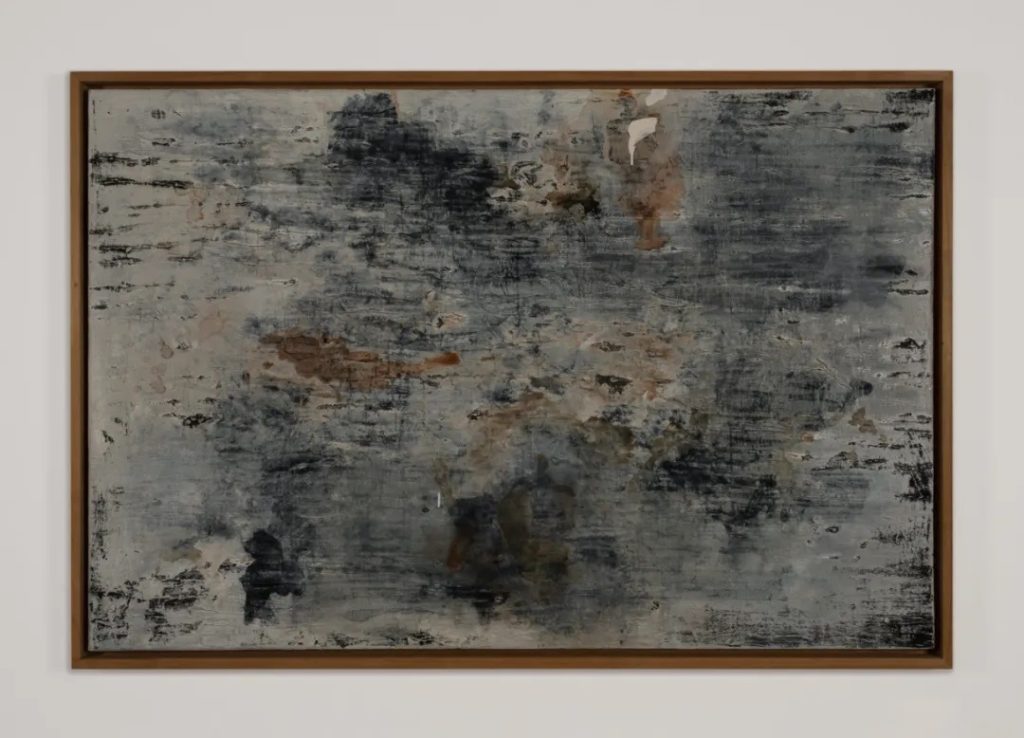
Untitled
Oil on canvas
120x180cm
47 1/4×70 55/64 in
2016-2017
Yang Wen ©